
by Cody Glen Barnhart
Since as early as the ninth century, various selections from Gregory of Nazianzus have been read on select feast days in the Orthodox church.[1] For several years, I’ve returned to these orations during Holy Week to help center my own devotional life and contemplate the nature of the resurrection of Christ. This year, however, I have been struck anew by the humility of Gregory’s reflections—not just in terms of how he describes the humility of the Son’s crucifixion, but the humility of the theologian in service to God.
The first of these liturgical readings, given the title “On Pascha and His Slowness,” does not begin with an exposition of the empty tomb or a typology of Jesus’s resurrection, as one might expect. Instead, Oration 1 is a sermon delivered to a flock Gregory never intended to shepherd. After being ordained by his father against his will, Gregory takes up his pastoral duties humbly sometime around 361–362. As scholar Fredrick Norris said of Gregory’s attitude, Gregory “understood the necessity of pastoral duties, but often found them to be destructive of his contemplative endeavors.”[2] Oration 1 reflects this tension, and Gregory is surprisingly candid about the weight of the task before him. Gregory begins with a charge to his flock (Oration 1.1):
It is the day of resurrection and an auspicious beginning. Let us be made brilliant by the feast and embrace each other. Let us call brothers even those who hate us, and much more those who have done or suffered anything out of love for us. Let us concede all things to the resurrection . . . I enter with a mystery, bringing this good day as an ally for my cowardice and weakness, that he who today is risen from the dead may also make me new by the Spirit, and clothing me with the new human being may give to the new creation, to those born according to God, a good molder and teacher, one who willingly both dies with Christ and rises with him.
Caught in the throes of church disagreement, taking up an office he never aspired to hold, Gregory reminds his congregation that cowardice and weakness are not antithetical to the gospel—they are the very engine of it. It is through weakness that strength is made perfect (2 Cor. 12:9). The very foundation of our salvation is framed by how the Savior wields our weakness and subjects himself to human smallness. Or, as he says later in Oration 1.5, “[Christ] descended that we might be lifted up, he was tempted that we might be victorious, he was dishonored to glorify us, he died to save us, he ascended to draw to himself us who lay below in the Fall of sin. Let us give everything, offer everything, to the one who gave himself as a ransom and an exchange for us.” In light of the humility of Jesus Christ, Gregory humbly takes up the task of ministry before him.
Nearly twenty years later, more firmly established in his public persona, Gregory makes a similar rhetorical move against the Eunomians, a group of false teachers threatening the Nicene definition of the Trinity. Eunomius and his contemporaries struggled to reconcile the unbegotten nature of God with the increasing Nicene support for an eternally-generated Son who shares in the divine nature. They began to teach that the Son had to be a different kind of substance than the Father because the Father could not generate an offspring that shared in his “unbegottenness.”
As these teachings gained a foothold in the church, Gregory responded with five orations about the doctrine of the Trinity. After spending two full orations explaining the meaning of various titles given to the Son of God in Scripture, Gregory pivots from dogmatic theology to an ethical command to, “treat all as God does, so that you may ascend from below to become God, because he came down from above for us.”[3] Once again, the humility of the Son becomes the onus of the Christian life. For Gregory, spiritual contemplation of Scripture’s words is the mechanism by which readers could become more like God and emulate Christ’s embodied life. In order to “ascend from below to become God”—in order to “treat all as God does” and consider them more important than oneself—we must first understand the nature of the subjection of the Son of God, turning to the Scriptures and seeking to understand the mystery of the Gospel.
In other words, as we continue to contemplate the cross, we should grow in sanctification. As we walk through Holy Week, we should not just look inward. We should look outward. The wine and gall of the crucifixion should not embitter us; it should empower us to consider the moral obligation of Christian character.
When referencing this passage from Gregory’s Orations, I like to show my students the way Gregory’s logic matches the pattern that Paul gives in Philippians 2. In fact, this is one of Paul’s most direct commands for the Christian to pursue humility and unity—and the very example he gives is the profundity of the incarnation. I’ve included the full context of the so-called “Christ hymn” here to show how deeply connected Paul’s ethical instructions are to his theology of the Son’s humility:
If, then, there is any encouragement in Christ, if any consolation of love, if any fellowship with the Spirit, if any affection and mercy, make my joy complete by thinking the same way, having the same love, united in spirit, intent on one purpose. Do nothing out of selfish ambition or conceit, but in humility consider others as more important than yourselves. Everyone should look not to his own interests, but rather to the interests of others. Adopt the same attitude as that of Christ Jesus, who, existing in the form of God, did not consider equality with God as something to be exploited. Instead, he emptied himself by assuming the form of a servant, taking on the likeness of humanity. And when he had come as a man, he humbled himself by becoming obedient to the point of death—even to death on a cross. For this reason, God highly exalted him and gave him the name that is above every name, so that at the name of Jesus every knee will bow—in heaven and on earth and under the earth—and every tongue will confess that Jesus Christ is Lord, to the glory of God the Father.
Paul calls us to have the mind of Christ [τοῦτο φρονεῖτε ἐν ὑμῖν ὃ καὶ ἐν Χριστῷ Ἰησοῦ] and, in doing so, to emulate the humility of Christ. It is the Son’s very self-emptying that earns his exaltation; it is his humility that establishes his throne. And, as Paul says and Gregory echoes, we should do this too. When we contemplate the humility of the Son during Holy Week, we should be spurred to Christian obedience by putting off self-interest, forgiving those who wrong us, and embracing our weaknesses. We should exhibit the kind of selflessness depicted at the Cross, where the Son of God did not exploit his equality with the Father but, rather, bore our likeness and died our death.
Having assumed a human mind and attained its salvation, the incarnation and obedience of Christ redefines what it means for you and me to be human. It is only through partaking in the Son’s embodied and subjected life that we may recover our true purpose—that we may become more human and therefore linger upon a truly spiritual vision of the Triune God.
As we approach Easter this week, many of us will envision scenes we have imagined several times over: the triumphal entry, Christ’s walk down the Via Dolorosa, his flogging and his ascent of the cross. This year, however, I challenge you to concede all things to the resurrection. Recognize that Christ’s emergence from the grave first required his entombment, that Good Friday is the motive for the good life, and that we are most like God when we embrace the weakness of the cruciform life. Walking like the Son in humility, consider how we should share in the sufferings of the subjected Son, which will one day lead to our glorification when we are presented righteous before the Father.
[1] These orations have been recently compiled and published by Sr. Nonna Verna Harrison as Gregory of Nazianzus’s Festal Orations (vol. 36 in SVS Press’s Popular Patristics series).
[2] Fredrick Norris, Faith Gives Fullness to Reasoning, 8.
[3] Gregory of Nazianzus, Oration 30.21.
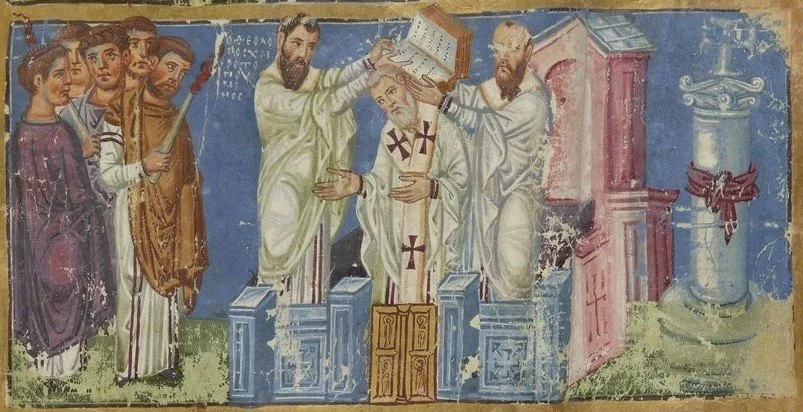
Pictured: the Consecration of Gregory of Nazianzus (ms. gr. Paris. 510, f. 452r)
