
by TY KIESER
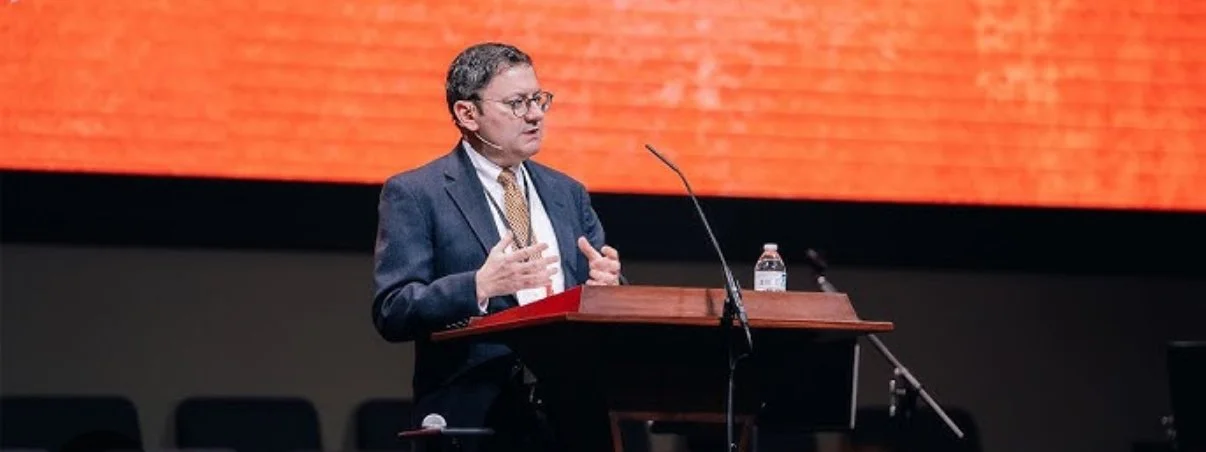
Dan Treier was an Evangelical professor in the very best sense. His entire life was about the profession of the gospel of Jesus Christ. His pilgrimage of earthly profession ended on December 22nd, 2025, but as one of the least pretentious, most humble, and most self-deprecating people I’ve ever met, he would be the first to remind us, “what we profess is not ourselves, but Jesus Christ as Lord” (2 Cor 4:5).
I knew “Dr. Treier” for over a decade, first as a PhD student, then as a fellow instructor at Wheaton College, and then (at some point through the years) as a dear friend. Looking back on the hundreds of hours that we spent together sitting in his office, eating lunch, wandering around the golf course, and walking his dog, I might characterize many of our conversations as different iterations of him answering my question, “What does it mean to be a faithful evangelical professor?” His life answered this question, and I can’t think of a better way to communicate his theological influence on me and the church than that. His life isn’t reducible to this one aspect, but those other aspects are maybe best saved for his wife and daughter to share if they wish or to keep for just themselves.
Dan would tell me that being a professor is really a combination of four roles: teacher, mentor, administrator, and writer. And an Evangelical professor’s life should be oriented toward the service of the church, a disposition that should mark the entire life of a professor and a Christian.
DAN THE TEACHER FOR THE CHURCH
Dan loved to teach and he loved his students. He began teaching at Wheaton College when he was just 28 years old. He remained there for the next quarter of a century. He constantly thought about pedagogy and theological content, initially manuscripting out the entirety of his two-hour lectures and ending his career still thoroughly prepared for every classroom he stepped into. Even with 25 years of classroom experience, he was considering different ways to encourage learning and formation in his classes. From meeting with students to discuss their classroom participation, to spending hours (plural!!) pouring over each student’s paper, his effort for his students was nearly always above and beyond anything we expected (or deserved). The content of his teaching dripped with the words of Scripture. Throughout his life he memorized several complete books of the Bible, and while he never flaunted it, there was frequently a biblical quotation or allusion layered into his speech. His gifts for teaching were also utilized in the church. The content of one of his most recent books was delivered in an adult Sunday School class at his church, as he slowly taught his way through the faith that was once for all delivered to the saints. Ultimately, he cared if his students learned the content, but he cared more if we grew in wisdom through the content.
DAN THE MENTOR FOR THE CHURCH
Hundreds of students, undergraduate and graduate, sat under Dr. Treier’s teaching. But a few of us got the privilege of seeing him more frequently as our mentor. He cared so deeply for all his students, and those whom he met with regularly received a particularly compassionate level of attention. He cared about our families, emotional health, and current/future ministries. He kept detailed prayer lists for his loved ones and dedicated significant prayer time to his mentees. He often started off a meeting with some quip about the most recent sports news (esp. the Tigers, Red Wings, or Buckeyes), but then he deftly moved into a conversation about the nuances of whatever theological question we were chasing down with grace and dexterity. Even topics that I knew he had not addressed in print or focused on in his teaching, he could navigate carefully and thoroughly. Beyond the academic contours and debates, he could comfort our hearts as we were anxiously stewing about some decision or relational situation. This was true not only for those of us who were formally working with Dan, but also for dozens of younger theologians whom he checked in on, supported, and cared for. He didn’t have to send those emails, schedule those coffees, or stop for those conversations, but he frequently did. And he did so not because there was some professional benefit to him, but because he cared about the future of the church. As one small piece of evidence of his mentorship, there are hundreds of books influencing the church today bearing Dan Treier’s fingerprints. From dialoging with those authors during the early planning stages to advocating for their publication and endorsing them with exacting honesty, Dan’s influence on the evangelical church will continue to be felt for decades through those books and those theologians.
DAN THE ADMINISTRATOR FOR THE CHURCH
During a time in our country and church when institutions are often perceived as hindrances to faithful service, Dan was deeply committed to the institutions he served. Whether it was Wheaton College, his daughter’s classical school, his church, or the book series that he guided for publishing companies, he poured his heart and soul into these communities. His administrative gifts allowed him to serve in multiple leadership roles in these places and as one of the most influential editors of our day—evidenced by his oversight of the nearly 400 contributors to the third edition of the Evangelical Dictionary of Theology, the dozen or so of volumes in the IVP Academic Studies in Christian Doctrine and Scripture, and multiple books engaging Theological Interpretation of Scripture. This doesn’t mean that he didn’t gripe about the bureaucracy or inefficiency of any given institution, but it does mean that he viewed institutional service as a means of loving his neighbors—his neighbors within the community and those whom the institution served. His daily presence in all of these places will be greatly missed, but his impact on the schools, series, and places that he served will continue.
DAN THE WRITER FOR THE CHURCH
Dan’s research started in the Theological Interpretation of Scripture movement, helping the church understand what it means to read the Bible Christianly and faithfully. His articles, monographs, and edited works on the topic led him to be one of the leading lights in this fast-evolving and influential movement. Yet, he refused to merely sit behind the lines and prescribe a theological method for others to follow. Instead, he carried out his methodological commitments in his research on Christology, ecclesiology, education, technology, and biblical commentaries (especially on Hebrews, Proverbs, and Ecclesiastes). In addition to the usual suspects of the historic Christian tradition, the more recent thought of Dietrich Bonhoeffer, Jacques Ellul, and Oliver O'Donovan littered his footnotes and undergirded his thinking. His prose was rarely flowery and overly ornate, but it was exacting, clear, and devotional. I once complained that he was able to say something in one sentence better than I could say it in three—Dan didn’t disagree.
For someone with his intellect and gifting, he could have stayed in the ivory tower his entire career. But his care for the church and her health often led him to write directly to pastors and lay people. And even viewed the writing process as a collaborative and churchly endeavor. He explicitly sought to co-author chapters and articles with his students, kindly giving us credit for what was largely his work. Further, he sought out feedback from students and friends incessantly. Dan organized multiple lunch conversations where he subjected his writing to the criticism of occasionally pugilistic graduate students. I’m not sure if he benefitted from those meetings, but I did. Once his books had gone to print, he kept copies of them on a shelf in his office next to books written by his students and friends. Yet, through it all, he refused to view publications as feathers in his cap and, instead, understood them as resources for the flourishing of the church of Jesus Christ and the exaltation of his name.
CONCLUSION
Dan Treier taught me so much about the Lord, life, and learning. I don’t think I could begin to quantify his influence on my life and I’m surely unaware of the various idiosyncrasies that I picked up from Dr. Treier. Even if I were never a formal college “professor,” I wouldn’t regret one second of my time in the Wheaton PhD program, mostly because of Dan Treier. He taught me that wisdom is worth more than many rubies and that friends lay down their lives for one another. He taught me what it means to be an evangelical professor, not as a career, but as a Christian professing the good news of Jesus.
With grief in my heart in the midst of the tension between the advents of Christ, I conclude with a biblical text that Dan himself referred me back to multiple times:
Let us give thanks to the Lord for his unfailing love
and his wonderful deeds for humanity.
Let us exalt him in the assembly of the people
and praise him in the council of the elders. . . .
Let the one who is wise heed these things
and ponder the loving deeds of the Lord.
Psalm 107:31–32, 43
